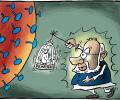
Has Modi -- after announcing the life-crushing demonetisation, the abrogation of Article 370 and the CAA/NPR/NRC without any consultation -- suddenly realised the value of taking everyone on board, asks Krishna Prasad.

The 'bumbling liberal' and the 'neo-fascist' are two sides of the same coin. Neither has place in a moderate India, says Nikhil Inamdar

While Rajya Sabha Chairman M Venkaiah Naidu asked the protestors not to make the House a "clog in the wheel" of progress, Lok Sabha Speaker Sumitra Mahajan said they should keep in mind the larger interests of the nation.
'Today, environment has become an issue of political debate. It has become a media issue. I think that is a good development.'

'Absolute non-violence is not only sinful, but immoral.' 'This doctrine of non-violence benumbed the revolutionary fervor, softened the limbs and hearts of the Hindus, and stiffened the bones of enemies.' A revealing excerpt from Vikram Sampath's Savarkar (Part 2): A Contested Legacy, 1924-1966.

Shastri took the first big step to transform India's agriculture, the benefits of which his successors reaped in plenty, says A K Bhattacharya.

Persistent efforts by the Board of Control for Cricket in India and its full members to block implementation of some crucial recommendations of the Justice Rajendra Mal Lodha committee on Wednesday provoked the Supreme Court to observe that public functions relating to cricket can be taken over by the government with the enactment of a law in Parliament.

Ajit Doval is now India's all-powerful security boss. This concentration of power disrupts our layered security system. Will it not weaken whatever remains of the power and authority of the home, defence and finance ministers? asks Shekhar Gupta.

The stage is now set for the controversial three-day cultural event opening on Friday on the Yamuna flood plains even as Art of Living guru Sri Sri Ravi Shankar struck a defiant note that he will not pay Rs 5 crore fine imposed by Green Tribunal and would rather go to jail.
Arun Shourie, a minister in the Atal Bihari Vajpayee Cabinet, has hit out at the Narendra Modi government, saying its economic policy was "directionless" while the social climate was causing "great anxiety" among the minorities.
'We need to be in a perpetual state of aggression, and able to swiftly change the goal posts to keep Pakistan in a state of imbalance,' argues Sanjeev Nayyar.

The letter says Maoists want to assassinate Modi the way former PM Rajiv Gandhi was killed, say Maharashtra CM and the state police.

The CPI-M leader also demanded the setting up of a House Committee to examine the latest developments in various central universities.

'The nominations were not meant to last permanently, but depended on the government of the day.' 'There was no question of revoking it during Congress, Janata Dal or even Vajpayee's NDA rule.' 'But Modi is different.'

'One wonders if he has decided on the disastrous course of taking after Manmohan Singh, sitting like a Madam Tussaud wax figure, the same expressionless face, eyes unblinkingly staring in front, and making absolutely no difference, and no contribution, to the House proceedings,' asks B S Raghavan.

Article 370 is an anachronistic decree that has outlived its utility, militates against India's sovereignty, and discriminates against both Indians and Kashmiris by mutually excluding each other from syncretic growth. It is redundant, can be debated and constitutionally discarded, says Vivek Gumaste.

An MP's is a full-time job, so is the BCCI president's. How can Anurag Thakur do justice to both, asks Sudhir Bisht.

The verdict in the right to privacy case is historic and of global significance because it establishes dharma, righteousness and destroys adharma.
The verdict in the right to privacy case is historic and of global significance because it establishes dharma, righteousness and destroys adharma.

'The irresistible charm of Indian politics is it can always throw up surprises -- even when it looks as predictable as in Tamil Nadu,' discovers Shekhar Gupta.
'After Vajpayee-Advani, Modi-Shah is the second best in India.'
The real danger in India is not majoritarianism but minorityism, a bane we have already experienced. Majoritarianism in the India context means plurality and tolerance. No one needs to fear, says Vivek Gumaste

Here comes the moment of truth. Modi prides himself on offering an "incorruptible" government. Will he dilute the Prevention of Corruption (Amendment) Bill to coax the administration's fealty and compromise his self-image?
Gujarat Lokayukta Justice R A Mehta's resignation letter is a stinging indictment of the Narendra Modi government's obstructionist attitude towards a constitutional watchdog.
he has to demonstrate the ability of his government to take a quantum leap, almost tantamount to setting the Ganga on fire, in the next six months, if not in 100 days, if the people were to take seriously the cascade of commitments spewing out of the President's address to both Houses of Parliament on June 9, says B S Raghavan. B S Raghavan suggests five practical propositions through which the Modi government can bring in paradigm changes.
If we have to elect Rahul Gandhi to rule the country because 'secularism', of all things, dictates it, we are strengthening the ugly aspects of the dynastic system of democracy that has come to infect India's body politic deeply, says Jaya Jaitly.

The euphoria of Ab Ki Baar Modi Sarkar will fade quickly if the Modi government does not raise its game, and focus significant monetary resources and managerial skills on making India's infrastructure truly world-class, says Ram Kelkar.
'His politics is pure power politics. It's defined by the struggle that he has gone through.' 'Like Indira Gandhi, he is always suspicious about the people who surround him, he is lonely as he does not trust anyone. And he will not allow anyone to challenge his superiority, be it individual or institutions,' says Ashutosh.

'The day-to-day control of banks is in the hands of political bosses and bureaucrats who are not answerable.' 'The political system uses the banks as a helicopter to throw money to the sector they want to patronise in order to win the next election.'

'They are acquiring agricultural land almost free of cost promising an illusory rise which is worse than a chit fund scheme.' 'When I went there on a fact-finding mission, we found that one third of the land they plan to acquire is the best agricultural land in the country.'

DLFknowingly suppressed material facts: Sebi
'Nobody would dare directly target Modi, and while there are murmurs about Amit Shah after Bihar, nobody is willing to say this openly. Arun Jaitley, in some calculations, is most expendable for Modi,' says Shekhar Gupta.

Rediff.com gives you a look at newbies in the Council of Ministers

'We are passing through a very historical moment. The UP election next year and the Lok Sabha election of 2019 will decide the course of India.' 'Maybe the unlettered will save India again because they have inherited a different India and a different idea of India,' says eminent social scientist Achyut Yagnik.
'Decisions on nuclear power have so far been taken by a small select group, primarily interested in profiteering from their actions, stating 'secrecy' as necessary from the national security point.' 'This argument is false, because we are dealing with the 'civilian' nuclear power sector, which is open even to the IAEA,' says Dr A Gopalakrishnan, former chairman of the Atomic Energy Regulatory Board.

'If Indira Gandhi's Emergency proved anything at all, it established that India would be governed, to the extent it can be governed, democratically or not at all,' says Inder Malhotra.

'Every Ali obituary I read made the point that he 'transcended his sport' -- a reference to the many battles he fought with America even as he fought in America.' 'What the obituaries leave out is that Ali equally transcended the boundaries of geography and of information -- as witness the Chennai teen who assimilated that most mobile of fighters through still images shorn of context.'
 © 2026 Rediff.com - Advertise with us - Disclaimer - Privacy Policy - Sitemap - Feedback - About us - Terms of use - Grievances